In season late autumn: Chestnuts and Granny Smith apples
Granny Smith apples
Granny Smiths are a universally recognisable variety of apple. They even feature as the Beatles’ Apple Records design image. Granny Smith was also one of the first varieties to be widely shipped and sold in supermarkets, as its slightly tough skin protected it through the transportation and storage processes.
Often used for cooking, the Granny Smith has a slightly tart taste and holds its shape well. But it’s also delicious to crunch on raw.
It’s a fruit with Aussie roots – literally. Granny Smith’s namesake, Maria Smith, was an Englishwoman who moved to the outskirts of Sydney in the late 1800s. Her family grew a wide variety of fruit and veges, and Smith was a great pie maker.
She discovered hybrid seedlings growing near a creek where she’d discarded cores and peelings. To maintain the Granny Smith taste, the apple trees need to be grafted rather than pollinated, so Granny Smiths today are all clones of the original seedlings.
At just 260kJ, an average Granny Smith apple provides 3.4g fibre. So, while it has a high water content, like other fruit, crunching through that apple helps fill us up.
Recipes
• Fresh apple cobbler with golden syrup
• Cinnamon-stuffed apples
• Apple and fig crumble with almond chia topping
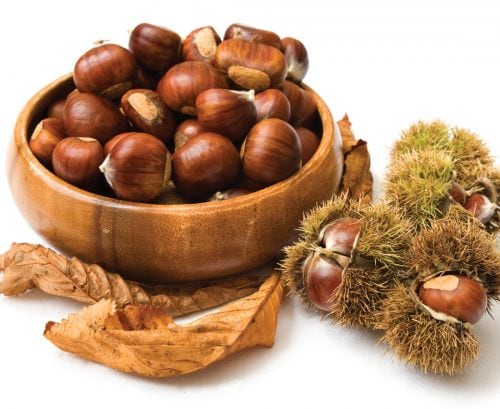
Chestnuts
Despite New Zealand being a grower of chestnuts, the majority of our crops go offshore to countries and cuisines that have delighted in their versatility and nutrition for centuries. Chestnuts have been used for sweet and savoury dishes, roasted, whole, puréed, used in stuffing or made into (gluten-free) flour for centuries, in Europe, Japan, China and the US .
Chestnuts were first introduced to New Zealand by early European settlers and most are either the European (Castanea sativa) or Japanese (Castanea crenata) varieties, or seedling hybrids of the two. By the late 1980s, NZ was exporting 100 tonnes of chestnuts. It is estimated in excess of 470,000 tonnes are produced and traded annually, worldwide. Japan, the sixth-highest producer, still needs to import an extra 33,000 tonnes annually (more than three times its own production) to fulfil consumer demand.
A half cup of roasted chestnuts has 750kJ, 2g protein, 2g fat, 0.3g sat fat, 35g carbs, 7g sugars and 6g fibre along with useful amounts of vitamin C and folate.
Fresh this month
Harvested in New Zealand gardens in May
Vegetables
Beetroot, broccoli, Brussels sprouts, cabbage, carrots, cauliflower, celeriac, celery, chillies, cucumber, eggplant, Jerusalem artichokes, kale, kumara, onion, parsnips, pumpkin, radishes, shallots, silver beet, spinach, spring onions, squash, swede, turnips, watercress.
Herbs
Basil, chives, coriander, dill, marjoram, mint, oregano, parsley, rosemary, sage, thyme.
Fruit
Apples, feijoas, figs, grapes, grapefruit, kiwifruit, lemons, limes, mandarins, passion fruit, quince, rhubarb, tamarillo, tangerines.
www.healthyfood.com

 Achieve your goals
Unlock your ultimate healthy eating toolkit
Get instant access to everything you need to plan, shop and eat well in one place.